How to Learn a Language With Your Partner Without Turning Dates Into Lessons
Practical rules and micro-habits for couples learning a new language together: a ten-minute daily routine, a do and don't list, and ways to keep practice playful so it never becomes homework or a scoreboard.

Learning a language as a couple sounds romantic and often ends as a chore: one person pulls ahead, the other feels judged, and Saturday evening turns into a grammar review. It does not have to. The trick is to keep practice small, shared and playful, and to draw a clear line between practising together and teaching each other. Here is how we would set it up.
The ground rules
Before the first session, agree on these out loud. It takes two minutes and prevents most of the arguments.
Ten minutes counts. A short daily session beats a long weekly one, for memory and for mood.
Nobody is the teacher. If one of you is further ahead, you are a partner with a head start, not an instructor. Explaining is fine when asked; correcting unasked is not.
Mistakes are content. Every error is a word or pattern to add to the shared list, not a point lost.
Practice is not a date. Dinners, walks and evenings out stay in your shared language unless you both agreed in advance that this one is in the target language.
Different speeds are normal. Compare each of you with yourselves last month, never with each other.
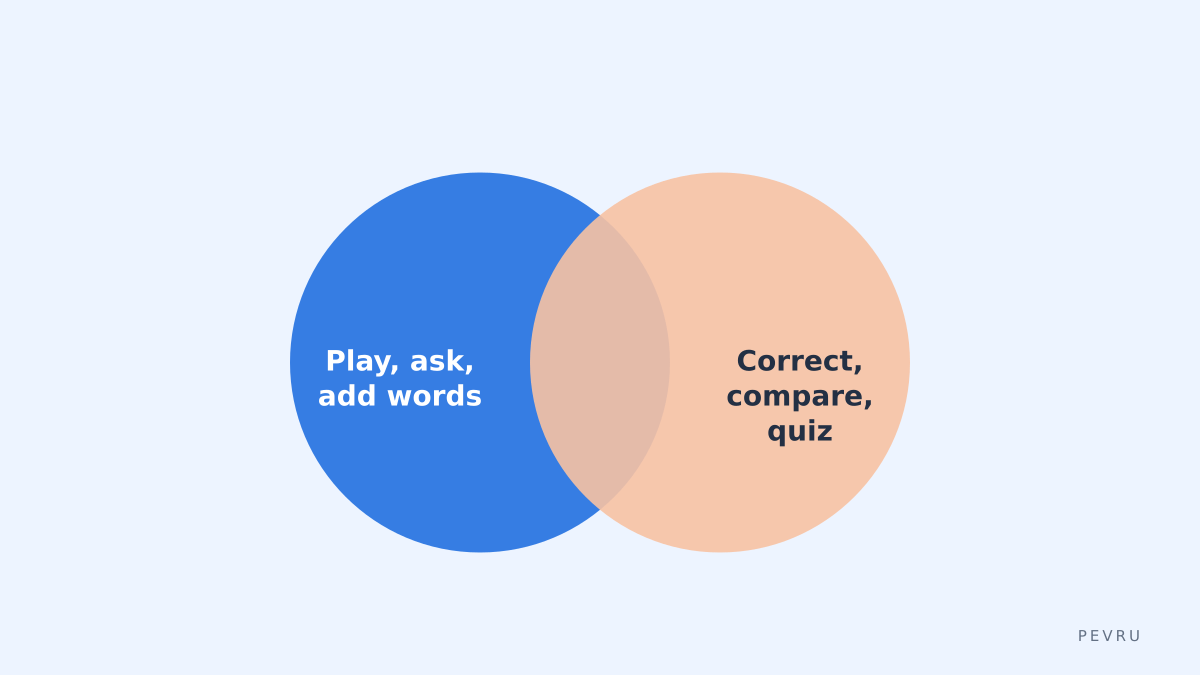
The ten-minute daily routine
This is the core habit. Do it at the same time each day, ideally attached to something you already do together, like the first coffee or the walk after dinner.
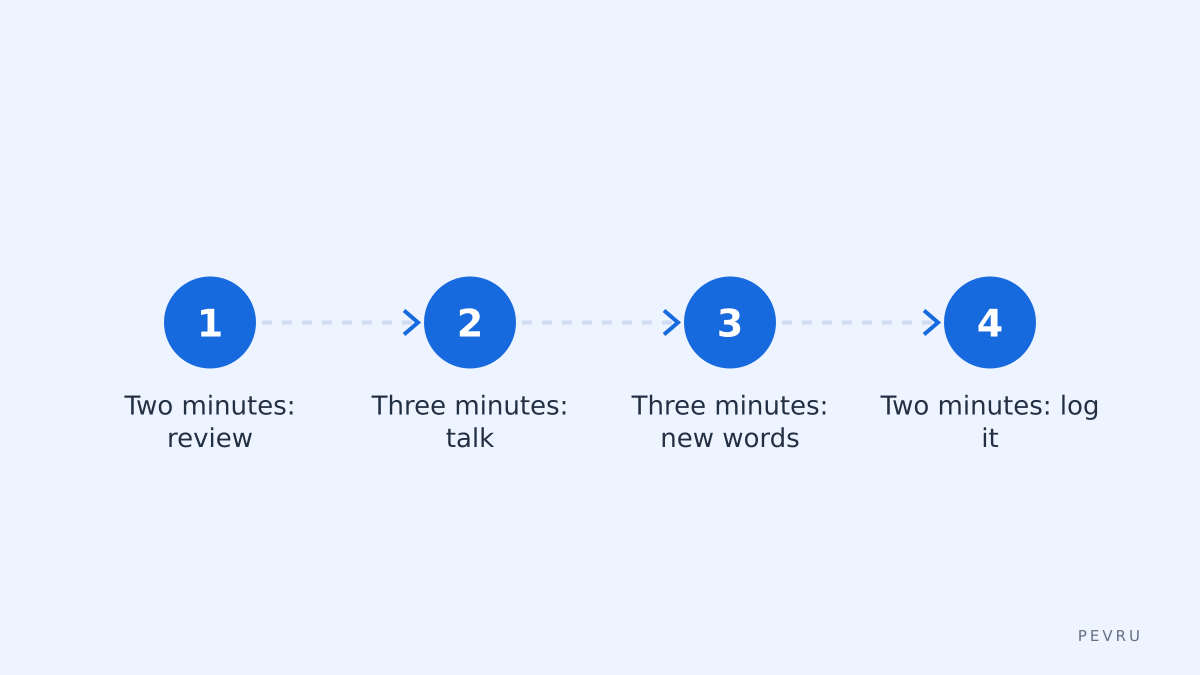
Minutes 0 to 2: review. Each of you flips through yesterday's words. Alone, on your own phone. No talking yet.
Minutes 2 to 5: talk. One prompt, in the target language, however badly. Rotate who picks: "what did you eat today", "describe the room", "one thing you are looking forward to". Gestures and pointing are allowed. Switching to your shared language for a single word is allowed. Giving up is not, for three minutes.
Minutes 5 to 8: new words. Whatever you could not say in the talk section becomes today's new vocabulary. Look it up together, say it aloud three times each, and add it to the shared list. Three to five words is plenty.
Minutes 8 to 10: log it. Mark the session done, note one thing that went well. Then stop, even if it is going well. Especially if it is going well; stopping while it is fun is what makes you come back tomorrow.
Ten minutes a day, six days a week, gives you roughly an hour of speaking practice weekly and twenty to thirty new words. Over three months that is a working beginner's vocabulary built from your own life rather than from a textbook's airport chapter.
Micro-habits that keep it playful
Label the kitchen. Sticky notes on the fridge, the kettle, the bin. Say the word when you touch the object. Remove a note when you both stop needing it.
One-word texts. Send each other a single word in the target language during the day. The reply has to use it in a sentence. Zero pressure, constant exposure.
Menu roulette. When you cook, name three ingredients in the target language before you start. Whoever forgets one washes up.
Song of the week. Pick one song, read the lyrics once together, then just let it play. By Friday you will both be mumbling along.
Wrong-word jar. Not a punishment jar. When one of you invents a funny wrong word, write it down. Reading the jar in a month is genuinely enjoyable and shows how far you have come.
Five-minute Friday film. Watch five minutes of a series in the target language with subtitles in the same language. Not the whole episode. Five minutes you will actually do.
Keeping the scoreboard out of it
Competitive features in language apps are designed for strangers, and they can be poison in a couple. If one of you is naturally faster, a leaderboard turns every session into proof of it.
Some tools handle this better than others. Duolingo's Friends Quests, for instance, pair you with a friend on a shared weekly goal rather than against each other, according to Duolingo's own announcement, which is a cooperative design worth copying even if you do not use the app: set a joint target, such as forty new words this week between you, and celebrate it together.
For tracking, we like a shared list that both of you add to, so the vocabulary reflects your life and belongs to both of you. Anki, a free spaced-repetition program, lets you review a deck alone at your own pace; a couple can maintain one deck and each review it separately, which respects different speeds while keeping the words shared.
If you would rather have the shared list, translator and cooperative streak in one place, LinguaPair is built for exactly this; in fairness, it is made by the same company that publishes this site. Its free tier at the time of checking gives you ten minutes of live translator a day, the beginner levels and a hundred stored words, which fits the routine above almost exactly. You could run your first two weeks of ten-minute sessions on LinguaPair and see whether shared streaks motivate or irritate you before paying anything.
Where it falls short: it currently covers seven languages, the translator is easy to lean on when you should be struggling productively, and the paid tier is a single subscription for the pair, so it only makes sense if both of you keep going. Tandem or HelloTalk are free alternatives for talking to native speakers outside the relationship, and a plain shared notes file plus Anki costs nothing at all.
When one of you falls behind
It will happen. One partner travels for work, gets busy, or simply finds the language harder. The wrong response is to slow the faster partner down or speed the slower one up. The right response is to change the format for a while.
The partner who is ahead switches to listening-heavy practice: podcasts, series, reading. Their progress continues without the sessions.
The partner who is behind keeps only the two-minute review and one-word texts until things settle. The habit survives even if the volume drops.
The joint session resumes with a topic the slower partner chooses.
Nobody quits, nobody catches up in a panic, and the target language stays part of the household.
A quick checklist for the first week
Agreed the five ground rules out loud.
Chosen a fixed ten-minute slot attached to an existing routine.
Picked the first three talk prompts.
Set up one shared vocabulary list you can both edit.
Labelled five objects in the kitchen.
Decided which evenings are firmly in your shared language.
Keep it small enough to survive
The couples who succeed are rarely the ones with the most ambitious plan. They are the ones still doing ten minutes a day in month four. Keep the sessions short, keep the corrections out, keep the words shared, and let the games do the work of motivation. If a purpose-built tool helps, LinguaPair's free tier is a low-risk way to try the shared format; check the current terms and availability on its site. If a sticky note and a shared list are enough, use those. The routine is the product.