Is Coursera Plus Worth It? A Break-Even Calculation Before You Subscribe
A simple formula for deciding whether the Coursera Plus annual or monthly plan beats paying per course, using the current prices and your own realistic pace, plus the cases where the answer is clearly no.

Some links in this article lead to partner services. If you make a purchase there, the site may receive a commission; this does not affect the price or our assessment.
Coursera Plus is either the best deal on the platform or a subscription you forget about after week three. Which one it becomes depends on a number only you know: how many paid courses or certificates you will realistically finish this year. Here is how I would run that calculation before entering a card number, with the current terms as a starting point.
What Coursera Plus includes, and what it does not
At the time of checking, Coursera describes Plus as unlimited access to more than 10,000 courses, Guided Projects, Specializations and Professional Certificates, with a certificate for every one you complete. Two plans exist:
Monthly: 24 US dollars a month with a seven-day free trial; cancel any time.
Annual: 160 US dollars a year with a 14-day money-back guarantee.
Excluded: degree programmes, MasterTrack certificates, and some individual courses and certificates that carry no Plus badge. Certificates earned in the first 14 days are revoked if you refund the annual plan in that window.
Prices and inclusions change, so treat the numbers here as inputs to the formula, not as the formula itself, and confirm them on the plan page.
The break-even formula
Coursera's default way of charging is per programme. Professional Certificates, for example, are billed monthly while you are enrolled, starting at 49 dollars a month at the time of checking; other programmes are billed per course or per month of enrolment, depending on the programme. So the comparison is:
Cost without Plus = sum of what you would pay for each course or certificate, for the months you stay enrolled.
Cost with Plus = 160 dollars a year (or 24 dollars per month you keep it).
Plus is worth it when the first number is bigger than the second. Using the certificate price as a benchmark, 160 dollars buys about three and a quarter months of one Professional Certificate. The break-even is therefore simple:
If you will spend more than about three months, in total, enrolled in paid programmes this year, the annual plan is cheaper. If you will spend less, pay per programme.
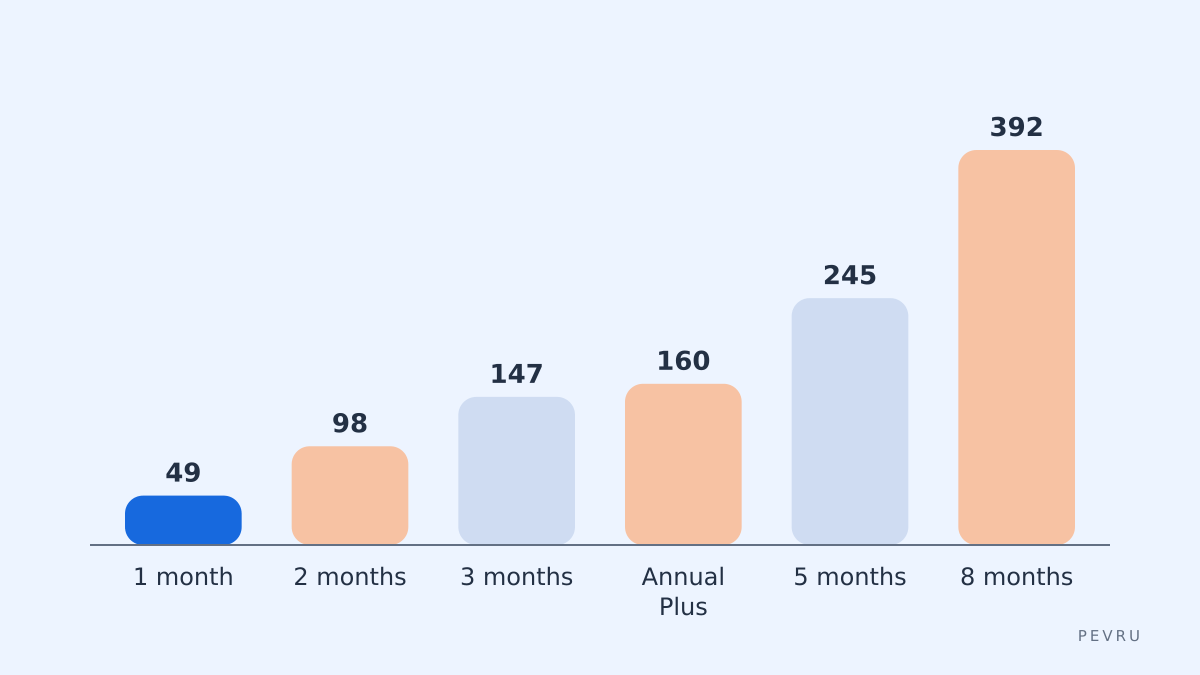
For the monthly plan the arithmetic is even blunter. At 24 dollars, it is cheaper than a single 49-dollar certificate month in every case. The only reasons not to pick monthly over per-course billing are a programme that is excluded from Plus, or a habit of forgetting to cancel.
Put your own numbers in
Work through these three lines honestly.
Programmes you will actually start in the next 12 months. Not the wishlist. Count only those with a date in your calendar.
Months each will take you. Coursera shows an estimated time for each programme; divide by your real weekly hours (most working adults manage three to five). Round up.
Total enrolled months = sum of line 2 across line 1.
Then compare:
Your total enrolled months | Cheapest option | Why |
|---|---|---|
0–1 | Audit free, or pay for one course | You do not need a subscription for one thing |
2–3 | Monthly Plus, cancelled when done | Cheaper than per-programme billing, no annual lock-in |
4–6 | Annual Plus | Break-even passed; annual undercuts six monthly payments |
7–12 | Annual Plus | Roughly a third of the per-programme cost |
Any, but all excluded programmes | Pay per programme | Plus does not cover degrees, MasterTrack or non-badged items |
If you land in the 4-to-12 row, the annual Coursera Plus plan is the straightforward choice, and the 14-day guarantee lets you test whether the specific programmes you want carry the Plus badge before the decision is final.
The two ways people get this wrong
Overestimating pace. The formula assumes you finish. Coursera's monthly billing quietly punishes slow learners on a per-programme basis, and Plus removes that penalty, which sounds like an argument for Plus. But an annual plan for someone who completes one course in twelve months is 160 dollars for something that costs 49 to 98 dollars per programme. The subscription only pays off if you keep moving.
Counting auditing as value. Many Coursera courses can be audited free: videos and readings without graded work or a certificate. If you learn for yourself and do not need credentials, you may not need Plus at all. Plus buys grading, feedback on assignments and certificates, not access to the lectures.
Limitations worth knowing
Plus does not include everything; the exclusions are exactly the most expensive items (degrees, MasterTrack) and a scattering of badge-less programmes, so check the ones you want.
Certificates are not academic credit. They carry the partner's name, which is useful on a profile, but they do not transfer to a degree unless a specific programme says so.
The annual refund window is 14 days, and certificates earned inside it are revoked on refund; do not rush a short course in that window to "get it free".
Regional pricing and payment methods vary; confirm availability and price in your country on Coursera's site.
If Plus does not fit, alternatives exist. edX sells similar university-partner courses one at a time with an audit option, and LinkedIn Learning offers a flat subscription to a curated library, though without the university names.
Conclusion
Coursera Plus is worth it when your realistic, calendar-backed plan puts you in paid programmes for more than about three months of the year; below that, pay per programme or audit for free. Run the three-line calculation, be pessimistic about your weekly hours, and check that your target programmes carry the Plus badge. If the numbers clear the bar, start the Coursera Plus trial or annual plan and put a cancellation reminder in your calendar on the same day, so the subscription stays a decision and never becomes a habit.