How to Start Freelancing With No Experience: A First-30-Days Plan
A day-by-day plan for the first month of freelancing when you have no clients and no portfolio yet: pick a service, build three samples, publish a first gig, price it sensibly and land the first order without pretending to be something you are not.

Some links in this article lead to partner services. If you make a purchase there, the site may receive a commission; this does not affect the price or our assessment.
Nobody starts with experience. The trick is to stop treating that as a blocker and start treating the first month as a project with a deliverable: one paid order, however small, from a stranger. Here is how I would run those thirty days if I were starting today, with the honest note that a plan does not guarantee a client; it guarantees that you will have done the work that makes a client possible.
Before day one: pick a service you can deliver this week
The most common mistake is choosing a service you would like to be good at rather than one you can deliver right now. The test is simple: could you complete it for a friend tomorrow with the tools you already have?
Good first services tend to share three traits. They are small, so a buyer risks little. They are repeatable, so you improve with each order. And they can be shown, so a sample proves you can do it. Examples: cleaning up spreadsheets, writing product descriptions, subtitling short videos, designing simple social media graphics, transcribing interviews, formatting résumés, basic WordPress fixes, translating short texts if you are fluent in two languages.
Write one sentence: "I help [type of buyer] with [specific task] so they get [result]." If you cannot fill the blanks, the service is too vague.
Week one: build the proof
Day | Task | Output |
|---|---|---|
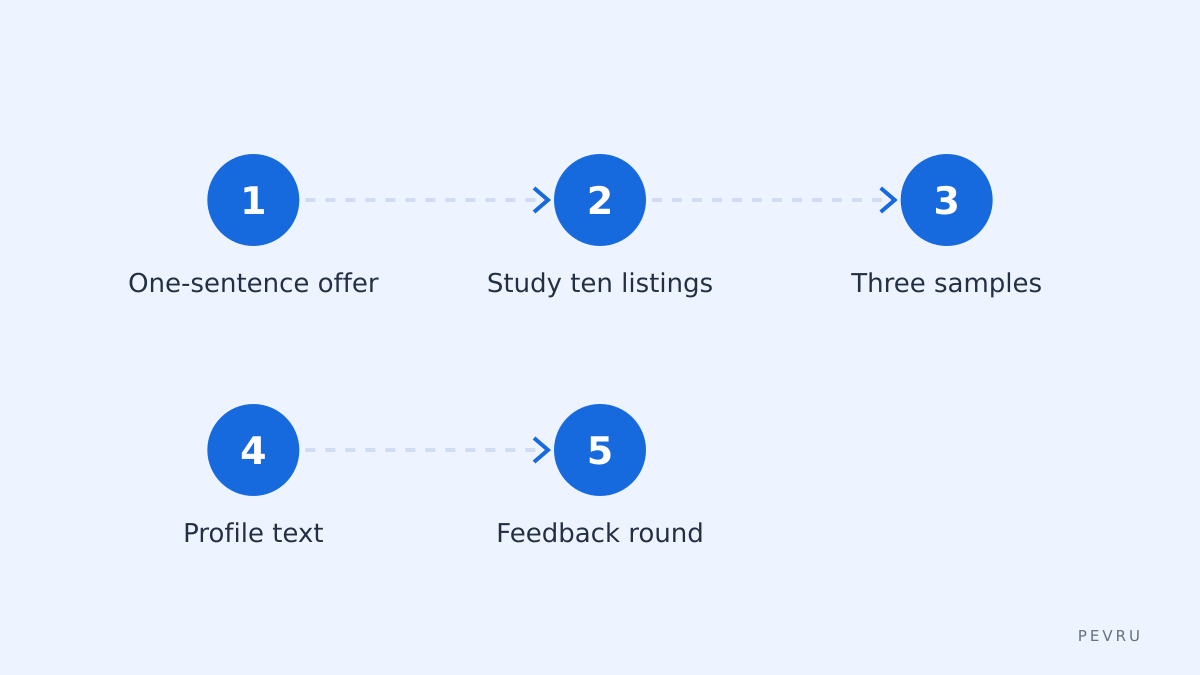
1 | Write your one-sentence offer and list three buyer types who need it | A note you will reread daily |
2 | Study ten listings for the same service on a marketplace; note packages, prices, delivery times | A comparison table |
3 to 5 | Create three samples that look like real client work, one per buyer type | Three portfolio pieces |
6 | Write a short profile: who you help, how, and one line about your background | Profile text |
7 | Ask two people you know for honest feedback on the samples | Fixes for week two |
Samples matter more than anything else in this month. A buyer cannot see your enthusiasm; they can see three pieces of work. Make them for imaginary but plausible clients, label them clearly as samples, and never present them as paid work.
Week two: publish, then price
On day 8 you publish. The fastest place to do that with no track record is a gig marketplace, because a gig listing sells without a proposal. On Fiverr, you describe a fixed service in up to three packages with set prices and delivery times, attach your samples, and the listing goes into the catalogue. Listing is free; the platform takes a percentage of each order as commission and adds a service fee on the buyer's side. Check the current rates in the help centre before you price, because they change and the figures repeated around the web are often stale.
Pricing with no reviews is uncomfortable. Here is how I would do it:
Take the median price from your day-two table.
Set your basic package at the low end of that range, not below it. A price far below everyone else signals inexperience rather than value.
Make the middle package the one you actually want to sell, with the deliverable a typical buyer really needs.
Keep delivery times honest. Late delivery hurts a new seller more than a slower promise.
Days 9 to 14: set up the second channel. On Upwork, the proposal-based marketplace, you create a profile and submit proposals to job posts using Connects; Upwork's help centre explains that each proposal costs a number of Connects shown on the post, that basic accounts receive a free monthly allowance, and that more can be purchased. Spend the week reading posts for your service and sending two or three carefully written proposals, not twenty generic ones.
Week three: the first order
By day 15 you have a live gig and a few proposals out. This week is about response speed and small adjustments.
Answer every message within an hour during your working day. Response time is one of the signals marketplaces use to rank new sellers.
Say yes to the small, awkward first order. A three-figure project is not the goal; a completed order with a review is.
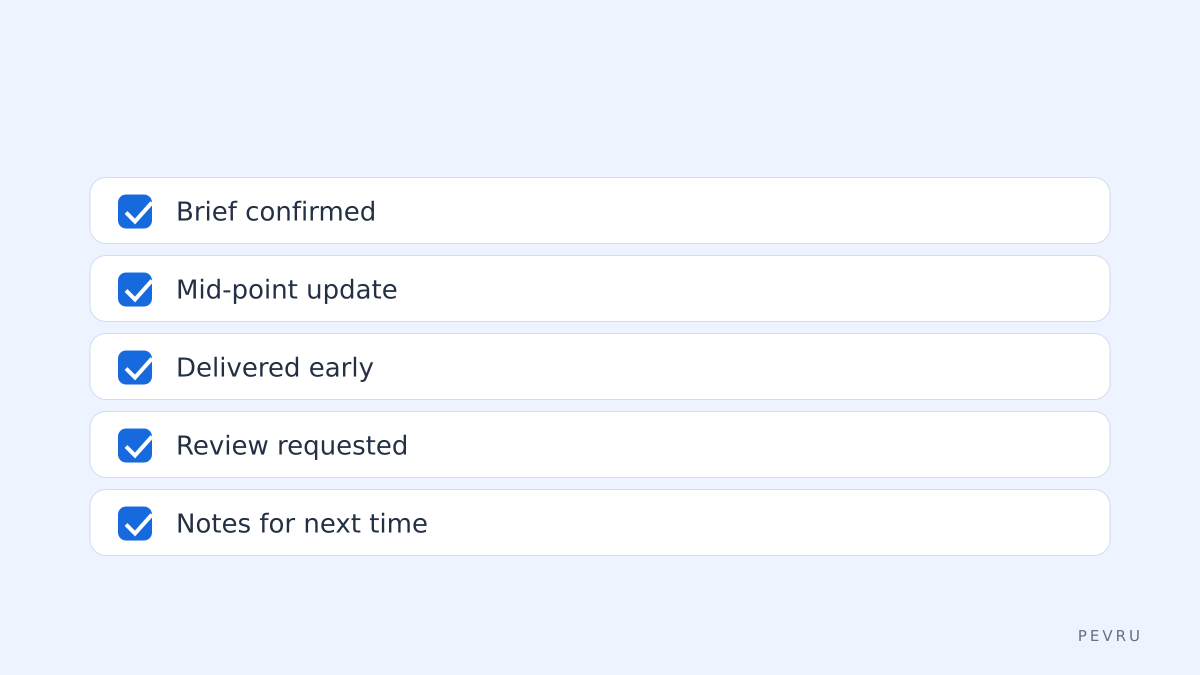
Over-communicate. Confirm the brief in your own words before starting, send a mid-point check-in, deliver slightly early.
Ask for the review politely, once. Never offer anything in exchange; platforms treat that as manipulation.
If nothing has arrived by day 21, change one variable at a time: the gig title, the thumbnail, the basic price, or the buyer type you target. Changing everything at once teaches you nothing.
Week four: review and set the next month
Days 22 to 30 are for looking at what happened.
Which of your three samples got the most views or questions? Make two more like it.
Which proposals got replies? Reuse their structure.
Did the buyer ask for something your package did not include? Add it as a paid extra.
Record hours spent and money earned. The first month's hourly rate will be dreadful; that is expected, and the number gives you a baseline.
On day 30, write the plan for month two in the same format: one deliverable, four weeks, one variable changed at a time.
Honest limitations of the marketplace route
Gig marketplaces are the fastest start, not the best long-term home. New gigs can sit unseen for weeks because the catalogue is crowded. The commission comes out of every order and every tip. A fixed-package structure punishes work that turns out larger than the brief. And you are building a reputation inside someone else's system, which you cannot take with you.
Upwork has the mirror-image problems: you spend Connects before you earn, and low-budget posts attract heavy competition. Direct outreach to local businesses, a simple personal website, and your own network avoid platform fees entirely, and most experienced freelancers end up with a mix. The marketplace is where you get the first review; it does not have to be where you stay.
Conclusion
The first thirty days of freelancing with no experience are a project with one deliverable: a completed paid order from a stranger. Choose a service you can deliver this week, build three honest samples, publish a gig on Fiverr with prices anchored to what the market already pays, send a handful of specific proposals elsewhere, and treat every message as a chance to demonstrate reliability. Whether or not the first order arrives by day 30, you will finish the month with a portfolio, a profile, a price list and a baseline, which is more than most people who are still waiting for experience to arrive.