Picking an eSIM for a Europe Trip: The Seven Things to Check Before You Pay
Skip the ranked lists. Before buying a Europe eSIM, check the country list, when validity starts, hotspot rules, top-ups, phone number, device compatibility and refunds. A short pre-purchase checklist for multi-country trips on a budget.

Some links in this article lead to partner services. If you make a purchase there, the site may receive a commission; this does not affect the price or our assessment.
Most articles about the best eSIM for Europe are ranked lists that go stale the moment prices change. Here is a different approach: seven checks to run on any Europe eSIM before you pay. They take about ten minutes and catch the mistakes that actually cost money on a multi-country trip.
First, a reality check on whether you need one
If your home carrier is based in the EU, you may not need a travel eSIM at all. The EU's roam-like-at-home rules let you use your domestic allowance across EU countries, plus Iceland, Liechtenstein and Norway, at no extra charge within a fair-use policy. The UK and Switzerland are not covered.
If you are arriving from outside the EU, or your route includes the UK, Switzerland, the Balkans or Turkey, a regional eSIM is usually the simplest option. Now run the checks.
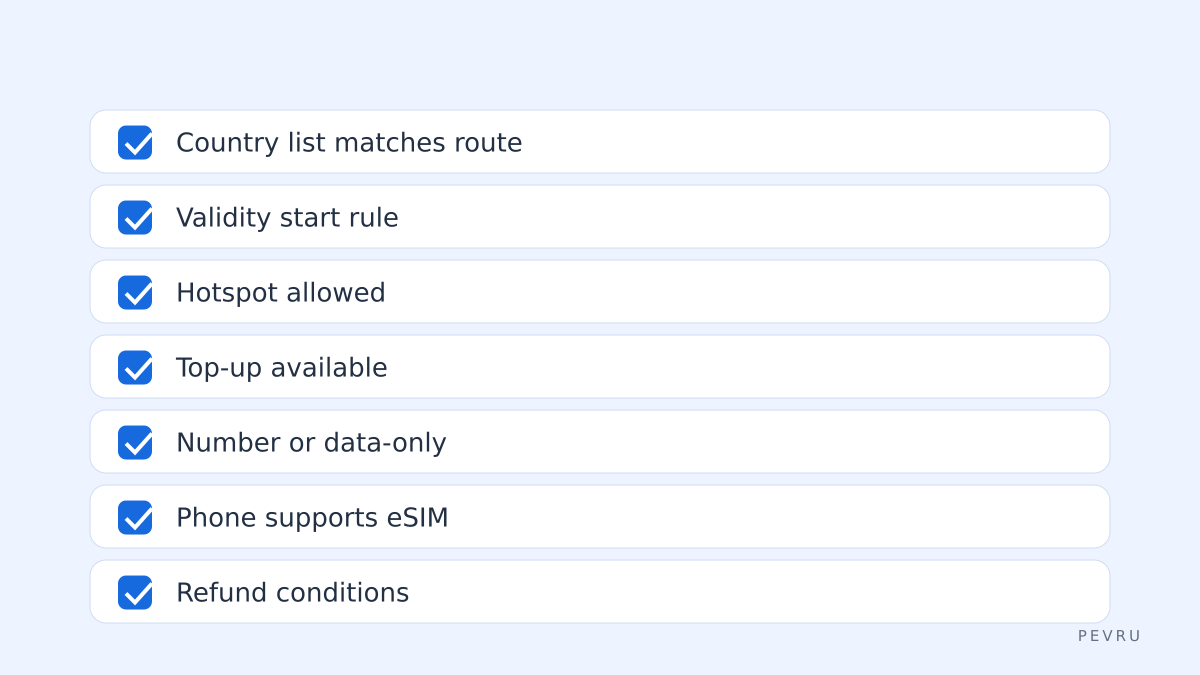
The seven checks
1. Does the country list match your actual route
"Europe" means something different to every provider. One regional plan may cover 42 countries, another 33, and the gaps are rarely the obvious ones. Global YO's Europe Explorer listed 42 countries at the time of checking; Holafly's Europe eSIM listed 33. Neither number tells you whether your specific border crossing is covered.
Do this: write down every country you will set foot in, including transit stops where you will switch the phone on. Open the plan's country list and tick them off one by one. Pay particular attention to Switzerland, the UK, Serbia, Bosnia, Albania, Montenegro, North Macedonia and Turkey, because coverage of these varies most between plans.
If one country on your route is missing, you have two options: a second single-country eSIM for that leg, or a different regional plan. Both are cheaper than discovering the gap at a border.
2. When does the validity clock start
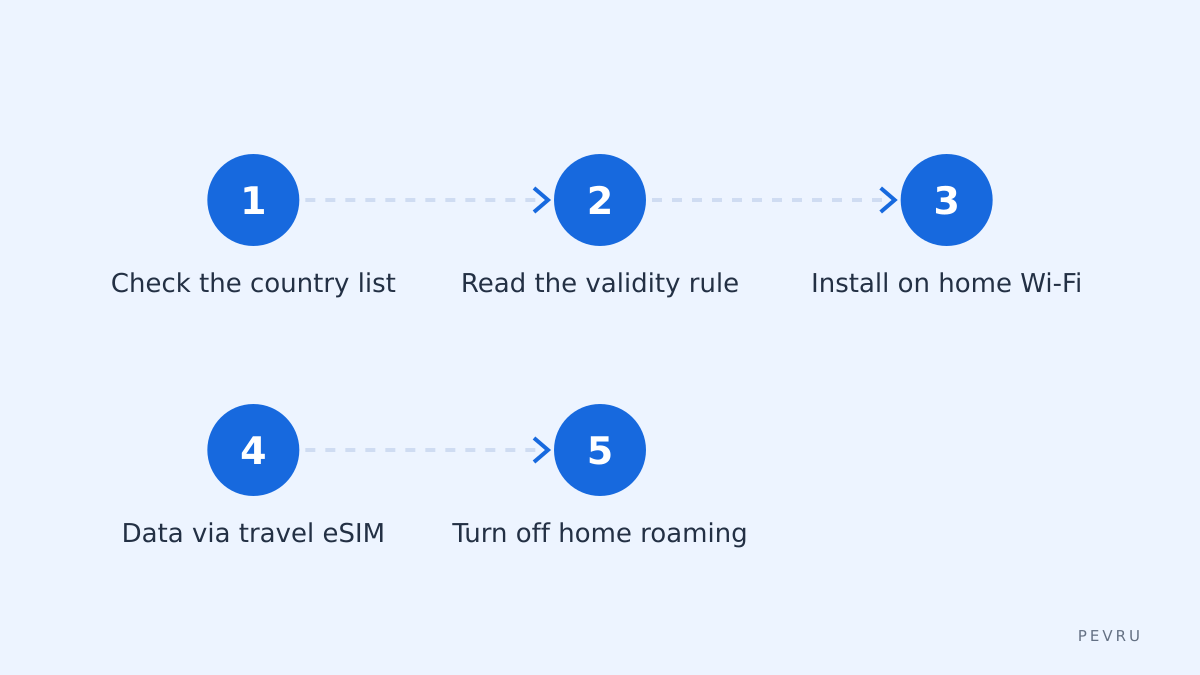
This is the check most people skip and most people regret. Providers use two models. Airalo's help page spells them out: for most packages the validity period starts when the eSIM first connects to a supported network in the coverage area, but for some it starts the moment you install the eSIM, even if you are still at home. Global YO's FAQ says that for a country where you are not currently located, you can install in advance and activation starts only after arrival, and its Europe Explorer page describes activation as immediate after purchase or manual when needed.
Do this: find the validity or activation policy on the package page before you buy. If it says "on installation", do not install until the night before you fly. If it says "on first connection" or "manual", install at home while you have good Wi-Fi.
3. Is hotspot sharing allowed, and is it capped
Travelling as a pair on a budget, the tempting plan is one eSIM shared by hotspot. Check two things: whether tethering is allowed at all, and whether it carries a daily cap. Holafly's Europe plan, for example, allows sharing 1 GB per day. Global YO's Europe Explorer page lists hotspot as supported, with the data coming out of the package pool.
Do this: if you intend to share, prefer a fixed-data plan with a pool big enough for two people, or buy two eSIMs. A daily sharing cap turns a shared unlimited plan into a rationed one.
4. Can you top up, or do you start over
On a two-week trip your estimate of data use will be wrong in one direction or the other. The question is what happens then. Some providers let you add data to the active eSIM in the app; Global YO's FAQ describes topping up an active eSIM from the My eSIM screen and also allows buying multiple eSIMs for the same country. Others require a new plan and a new installation.
Do this: look for a top-up option on the package page. Also note whether a top-up extends the validity period or only adds gigabytes. Airalo, for instance, states that validity cannot be extended, only data.
5. Do you need a phone number
Almost every travel eSIM for Europe is data-only. Global YO states plainly that its eSIM+ includes no phone number, and Holafly's plans are data-only as well. For messaging apps, maps and email that is irrelevant. It matters in three cases: restaurant or hotel bookings that phone you back, banks that send SMS codes to your home number, and car hire desks that want a reachable local number.
Do this: keep your home SIM active for calls and SMS, with data roaming switched off for that line. If you genuinely need a local number, a physical SIM from a local operator is the better tool for that trip, even though it means a shop visit.
6. Does your phone actually support eSIM in your market
Not every model does, and the same model can differ by the country it was sold in. Global YO's compatibility page lists brand families from Apple and Google Pixel through Samsung, Xiaomi, Oppo and Motorola, but warns that eSIM support may vary by region and market, with exceptions such as iPhones sold in mainland China.
Do this: in your phone settings, look for Add eSIM or Add mobile plan. Then confirm the phone is unlocked; a carrier-locked device can reject a foreign profile. Most providers, Global YO included, refund only unused eSIMs within a limited window, and generally do not refund compatibility problems after activation.
7. What are the refund conditions
Read this before paying, not after. Global YO's FAQ describes a full refund within 30 days for an unused, not activated eSIM, refunds for technical installation problems on their side, and no partial refunds for consumed data or expired plans. Other providers have similar but not identical rules.
Do this: buy no earlier than you need to, keep the order confirmation, and if the eSIM fails to install, contact support before your trip while the eSIM is still unused.
A quick decision list
Route entirely inside the EU, EU home carrier: use your own plan; no eSIM needed.
Route inside the EU, non-EU home carrier, light use: a small fixed-data regional plan; check the top-up option.
Route including UK, Switzerland or the Balkans: a regional plan whose list explicitly names those countries, or a second eSIM for the gap.
Two people, one budget: two small eSIMs usually beat one shared plan with a hotspot cap.
Stay longer than a month in one country: price a local prepaid SIM against the eSIM; the local SIM often wins.
Where Global YO fits, and where it does not
Global YO's Europe Explorer is a fixed-data regional plan with a 42-country list, several data sizes from small to very large, hotspot support and app-based top-ups, which suits the multi-country budget traveler this checklist is written for. If that matches your route, check the current Europe Explorer packages against your country list.
Its limitations are real: everything runs through the app, so you need it installed and working before you travel; the eSIM is data-only; and the country list still has to be verified against your route like any other. It is not the only option. Airalo's Europe eSIM covers a partly different set of countries, Holafly sells unlimited plans if you burn several gigabytes a day, and a local prepaid SIM remains the cheapest route for a long stay in one country.
Whatever you buy, run the seven checks, confirm availability and payment options for your country on the provider's own site, and only then pick a Global YO package or its competitor with confidence that it matches the trip you are actually taking.
Sources
- https://www.globalyo.com/esim/esim-europe-explorer/
- https://www.globalyo.com/faqs
- https://europa.eu/youreurope/citizens/consumers/internet-telecoms/mobile-roaming-costs/index_en.htm
- https://www.airalo.com/help/getting-started-with-airalo/E8DFWD88SHUX/when-can-i-install-my-esim/EQOCBMXDPSB2
- https://esim.holafly.com/esim-europe/